
A Troubled Europe
Issue #6- Thursday 6th March 2025

Editor’s Note
Hello everyone,
Welcome back to the Durham Diplomatic Digest, the Durham Diplomatic Society’s weekly publication covering all the major and underreported events from the past week from across the world.
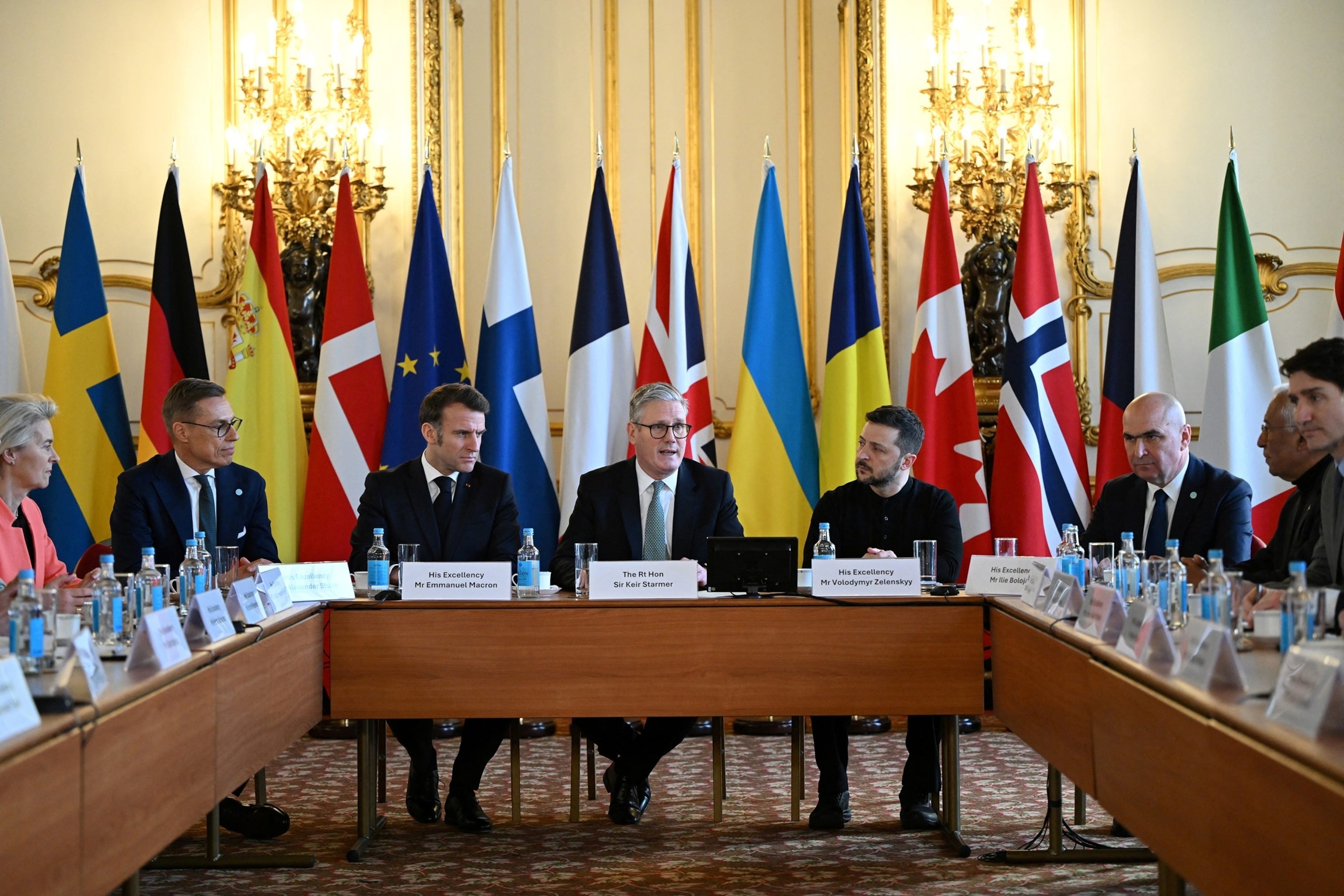
This week, European leaders have scrambled to combat the worrying decline of US support for the war in Ukraine following President Trump’s humiliation of Ukrainian President Zelensky in their Oval Office meeting. European leaders met in London earlier this week and are currently meeting in Brussels to demonstrate both a resilient front to Russia and the United States as well as to discuss defence spending and draw up a potential outline for a peace plan for Ukraine.
Despite these efforts, such an effort by European states is limited by the realities of the conflict. Without US support, European leaders will seldom be able to create or maintain peace in the conflict. The United States holds the most significant leverage to get both the Ukrainians and the Russians to the negotiating table, with the political power held by the European states relatively insignificant. As has been shown over the last few days, the United States holds overwhelming leverage, with the cutting of all aid and the suspension of all intelligence sharing with Kyiv proving potentially detrimental to the future of Ukraine’s war effort. The backing of the United States is the most important element of Ukraine’s war effort at this stage, and without such support, the Ukrainian state faces an existential threat.
While many of Europe's steps have been undertaken to ensure a solid defence for Ukraine and limit future Russian aggression, this has come with significant backlash. For example, in the UK’s attempt to take leadership in creating a staunch European front, Starmer announced a cut to international aid from 0.5% GNI to 0.3% to fund defence spending, a significant retreat of Labour’s prior commitment to restore the international aid budget back to 0.7%. This regretful decision has meant a reduction of approximately £6 billion going to international organisations in the most vulnerable corners of the world, from HIV drug-development programmes to emergency healthcare assistance in conflict zones. Germany, France, Belgium, and the Netherlands have also taken similar steps, highlighting an unfortunate and misguided approach by European allies. These states gain a significant proportion of international power not from their reliance on military spending but from the promotion of soft power, such as through international aid. To relinquish such obligations would be to relinquish a significant proportion of leverage that European states have within the international system. As such, such initiatives are not only redundant but significantly damaging to the credibility of European powers in supporting international relief efforts in the most dire circumstances.
As I wrote in last term’s edition, The Troublesome Path to Peace, “Both sides view their aims intransigently as a question of their own survival, and until a meaningful change in the paradigm of the conflict emerges, the chance of peace appears mute”. For the first time, a serious peace initiative is taking shape, but European states must acknowledge their role will likely be confined to accepting peace terms and implementing whatever deal is finalised. Ultimately, this demonstrates the fallows of Europe’s peace-making capabilities and the significant erosion of its influence on its own continent; a continent once the epicentre of Great Power competition has succumbed to the perils of external Great Power competition, to which European states are impotent in shaping.
This week, the Durham Diplomatic Digest has over 40 submissions covering the most notable events over the past week, from the developing conflict in the DRC to the removal of Apple’s ‘Advanced Data Protection’ for UK users. To get all the latest updates on all the major and underreported events across the world, please make sure to subscribe!
- Alexander Belay, Digest Editor
Upcoming Events…
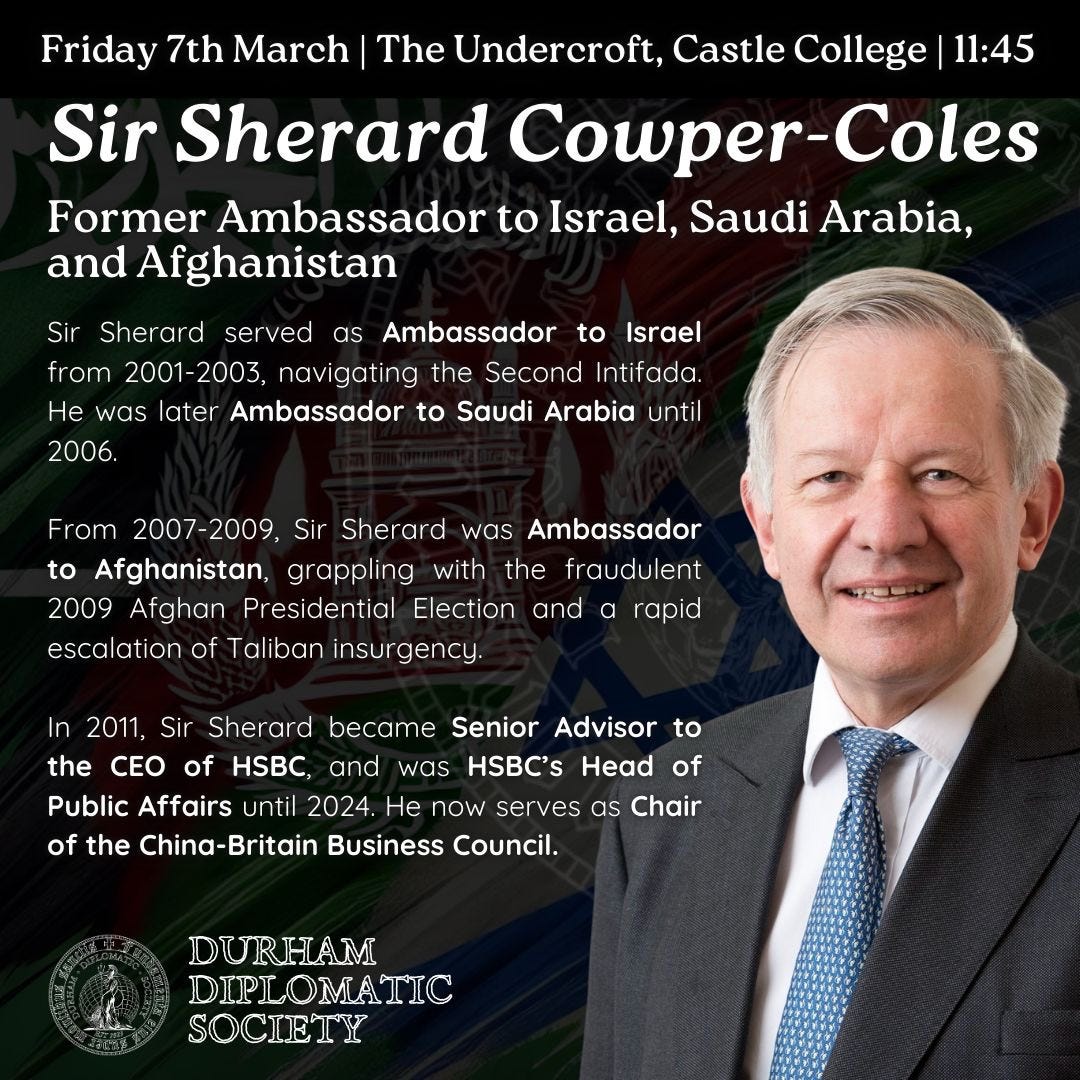
Fantastic Speaker Opportunities, Available to All Our Members…
Regional Roundup
The World at a Glance…
Asia-Pacific
Brought to you by Team Manager Benjamin Huthwaite, Mercedes Cheung, James Brine, and Seohyun Kim
Thailand Deported 40 Uyghur Men to China
Thailand forcibly deported 40 Uyghur men to China after a decade in Thai detention, sparking global condemnation. UN High Commissioner for Human Rights Volker Türk decried the move as a “clear violation of international human rights laws”, while US Secretary of State Marco Rubio condemned the forced returns. The men face possible prosecution or death in Xinjiang, with advocates urging immediate disclosures of their whereabouts and guarantees of humane treatment. AP News, SCMP, UN News
China's Expanding Grip on Myanmar's Future
As Myanmar's Junta faces unprecedented military defeats, Beijing is tightening its influence, leveraging economic projects, security agreements, and diplomatic pressure to safeguard its strategic interests. Despite China's rhetoric of non-interference, it has played all sides, arming both the military and ethnic resistance groups, while pressuring opposition forces to negotiate ceasefires and accept elections that serve Beijing's long-term goals. This highlights the contradictions in China's vision of a multipolar world order, where sovereignty and stability take a backseat to Chinese geopolitical dominance. USIP, Irrawaddy, Foreign Policy
North Korea’s Record-Breaking $1.5 Billion Cyber Heist
North Korean hackers have stolen $1.5 billion worth of Bitcoin from a cryptocurrency exchange, setting a new record for the largest heist in history. This surpasses the previous record held by Saddam Hussein, who looted $1 billion from Iraq’s Central Bank before the U.S. Invasion of Iraq. With international sanctions limiting its access to foreign currency, North Korea has turned to cybercrime as a major source of funding for its nuclear program. As the hackers attempt to launder the stolen funds online, ByBit—the targeted company—is seeking assistance from other firms to recover the losses. BBC, The Guardian, Sky
New Zealand Opposes New China Deal With Cook Islands
Last week's deal, signed by Cook Islands Prime Minister Mark Brown and China Premier Li Qiang, has brought about a wide new partnership between the nations across trade, infrastructure, education and seabed mining. However, complaints from Wellington say that New Zealand should have been consulted with the details of the agreement. The Cook Islands maintains a "free association" with New Zealand that agrees its right to self-governance while cooperating on matters of defence and security. Brown, who has just survived a Vote of No Confidence over the deal, argues that the agreement is purely economic, and that the Cook Islands should pursue opportunites in its own self-interest. BBC, The Guardian, Al Jazeera
Middle East and North Africa
Brought to you by Luke Sands, Avesta Afshari-Mehr, Lucia Lallana, and Lucy McCreery
Syria’s National Dialogue: Key Takeaways from a Political Shift
Syria’s National Dialogue marked a crucial step in the country’s transition after Bashar al-Assad’s fall. Discussions centred on a new constitution, sovereignty, and rights. While the dialogue emphasised freedoms and justice, last-minute invitations and uncertainty over elections raised concerns about inclusivity and the nation’s democratic future. DW, Al Jazeera, BBC
Nawaf Salam Government Wins Confidence Vote in Lebanon
The Lebanese government has won the confidence vote with the support of 95 lawmakers out of 128 seats. The government is pushing for economic reforms to boost their economy which has severely suffered since 2019. As well as this they want to start negotiations with the International Monetary Fund. The political landscape has changed significantly in Lebanon in that the political statement did not use language that legitimised a role for Hezbollah in defending Lebanon, just for their own armed forces. Al Jazeera, Independent, ABC
Israeli Military Failures Laid Bare
The Israeli military has published its first report on the failures of the Israeli Defence Force (IDF) to protect Israeli civilians on the 7th of October attack carried out by Hamas. The report details how the IDF focused on the threats from Iran and Hezbollah whilst completely miscalculating the threat from Hamas, believing their plans for an attack on Israel were “unrealistic or unfeasible.” Whilst the military intelligence directorate did highlight that Hamas’s plan was not merely a vision, but rather a “concrete framework for operational planning,” this was not brought to the attention of senior military figures and resultingly led to 5,000 Hamas gunmen invading Israeli territory, claiming the lives of 1,200 Israeli civilians and taking 251 hostages. BBC, Al Jazeera, The Times of Israel
Eight Sentenced to Death in Tunisia for the Murder of Left-Wing Figure in 2013
Last Tuesday, the Tunisian court sentenced 8 men to death for the murder of left-wing opposition figure Mohamed Brahmi in 2013, an assassination which triggered a political crisis across the country. According to local media, charges against the defendants also include “attempting to change the state's nature", "inciting for killing and armed conflict”, and "deliberate participation in premeditated murder". Brahmi was a nationalist of the People's Movement and a member of Tunisia's Constituent Assembly. He was an outspoken critic of the Islamist-inspired government dominated by Ennahdha at the time. The ninth defendant involved in Brahmi’s murder remains on the run. France 24, New Arab, Arab News
Europe
Brought to you by Team Manager Bryn Jones, James Gordon, Chloe Stiens, Emily Worlock, and Avesta Afshari-Mehr
German Election Shows a Divided Nation
The centre-right CDU/CSU now hold a slim majority in the Bundestag after elections last week with Friedrich Merz likely to become the next German Chancellor. However, the main talking point from last Sunday’s polls was the significant gains for the far-right party the AfD, who won almost all seats across the former East Germany. Merz has always had a strong transatlantic orientation, but after his election, he questioned the future of NATO. This election proves testing for Europe as a standing point for both the continent’s foreign policy and a rise of the far right across many of its nations. The Guardian, BBC, Chatham House
Starmer Cuts International Aid to Increase Defence Spending
Sir Keir Starmer has announced that UK defence spending is to rise from the current 2.3% of GDP to 2.5% by 2027, representing an annual increase of £6 billion. The move has proved controversial as it will be funded by cutting the overseas aid budget from 0.5% of GNI to 0.3%, despite a long-term stated commitment to return development funding to the UN target of 0.7%. The move came in the week when the Prime Minister flew to Washington to try to persuade the Trump administration to provide security guarantees to Ukraine in any peace settlement. Financial Times, The Guardian, AP
Ukraine-US Minerals Agreement Signed
President Zelensky travelled to Washington on Friday to sign a deal with the US. According to the agreement, a joint investment fund will be set up to facilitate Ukraine’s reconstruction, and Ukraine will contribute 50% of proceeds from state-owned mineral resources, oil, and gas to the fund. Trump’s original request, for Ukraine to pay the US $500bn of profits from these mineral resources as compensation for American aid during the war, is absent from this agreement. BBC, The Economist, Reuters
Trump-Macron Bromance Masks EU-US Diplomatic Gulf
Emmanuel Macron and Donald Trump met last Monday in Washinton to discuss EU-US relations and plans concerning the future of Ukraine and European security. Though the meeting was jovial– despite Macron correcting Trump over erroneous claims regarding European funding for Ukraine- and reinserted European interests into US-Russian discussions vis-à-vis Ukraine, it is clear that US-EU relations will not be as close as post-WW2, with Macron recognising the need for France, Germany and the UK to take greater initiative regarding European security as America’s commitment to Europe grows increasingly ambiguous. BBC, Politico, Le Monde
Dodik Defies Verdict, Republika Srpska Rejects State Court Ruling
Bosnian Serb leader Milorad Dodik vowed to defy a court ruling convicting him of disregarding the High Representative’s decisions. Backed by Serbia, Hungary, and Russia, Dodik denounced the verdict as politically motivated. Republika Srpska’s parliament rejected the court’s authority, escalating tensions in Bosnia and the wider Balkan region. BBC, Balkan Insight, Reuters
North America
Brought to you by Team Manager Humphrey Schuyler, Zara Hossain, and Ellie Bishop
UK Spared from Trump Tariffs
Starmer and Trump have been working towards a deal to exclude the UK from the threat of tariffs to be placed on its EU neighbours, asserting that it is a ‘very different place’ from the EU. Trump has affirmed relations with the UK, calling Starmer a ‘special man’ and saying that his support will always be with the British. Trump has endorsed the UK’s move to cede the Chagos Islands to Mauritius to secure a US-UK military base on the islands in the future, which has been preceded by an increase in defence spending by Starmer. Trump has been optimistic about the deals, highlighting the persistence of the special relationship. Financial Times, Sky, CNBC
Oval Office Meeting Descends into Tense Argument
A planned meeting between President Zelenskyy, President Trump and Vice-President Vance shocked the world by descending into a heated exchange of words on Friday, where the Ukrainian President was accused of being ‘disrespectful’ to America by Trump and Vance. In the discussion, Trump could be heard raising his voice and telling Zelenskyy “You’re either gonna make a deal or we are out”. This comes after Trump claimed he had no memory of calling Zelenskyy a dictator in an interview with Keir Starmer. Forbes, Al Jazeera, BBC
House Passes Budget Reconciliation Bill
House Republicans narrowly passed a multi-trillion-dollar budget reconciliation bill. The 217-215 vote tested Speaker Mike Johnson’s leadership as he worked to secure enough support after an earlier delay. The budget includes $4.5 trillion in tax cuts, offset partly by spending reductions but also increasing national debt, and seeks $2 trillion in cuts over a decade while boosting military and immigration enforcement funding. All Democrats opposed the bill, with Republican Thomas Massie voting against it due to concerns over fiscal discipline. Trump reassured that major social programs like Medicare and Medicaid would remain untouched, though Democrats criticised the bill as benefiting the wealthy at the expense of low-income families.BBC, ABC
Latin America
Brought to you by Team Manager James Bryant and Liam Reilly
Colorado Developer Assassinated at Luxury Belize Home
A well-known Colorado real estate developer was shot and killed in Belize over the weekend. Police believe the incident may have been the consequence of a professional hit job by a disgruntled coworker. On Friday evening, Boris Mannsfeld, 56, was discovered face down on his yard's floor, suffering from a gunshot wound to the back of his skull. Mannsfeld assisted in building the opulent villa complex at Maya Beach, Central America, called The Villas at Cocoplum, where the fatal tragedy occurred. Four years after relocating to Belize permanently with his family, he established Boris Mannsfeld & Associates, his own development company, in 2010. Fox News, Daily Mail, Breaking Belize News
Trump Cancels Venezuela Oil License
On Wednesday, Trump announced he would revoke a Biden-era license allowing Venezuela to export limited oil to the US through a joint venture with Chevron. Citing the Maduro administration’s failure to meet "electoral conditions" and delays in deporting migrants. The cancellation comes as a major blow to Venezuela, where US crude exports account for over a quarter of oil revenues. Chevron’s CEO warned that the move could strengthen Russian and Chinese influence in the country and drive further migration towards the US. BBC, Reuters, Wall Street Journal
Sub-Saharan Africa
Brought to you by Team Manager Avesta Afshari-Mehr, Jack Berryman, Nia Watson, Frederick Larsen, and Archie Longrigg
Namibia’s Wildlife Crime Fight Faces Uncertainty
The US government’s funding freeze threatens Namibia’s conservation efforts, impacting pangolins, rhinos, and elephants. USAID grants once supported anti-trafficking initiatives, law enforcement, and wildlife crime courts. Conservationists warn of dire consequences, urging self-sustainability and alternative funding. Meanwhile, German support persists, but urgent financial gaps remain in Namibia’s wildlife protection efforts. Namibian Sun, VOA
177 African Seed Species Stored in Svalbard Vault
Svalbard Global Seed Vault has seen over 100,000 seeds from nearly 200 plant species stored, in an effort to protect the future of the African nation's biodiversity. The protection of these seeds is vital in the fight against climate change, as well as state-rebuilding post-conflict. The species deposited are specifically selected by the World Agroforestry Center to aid nutrition and climate adaptation across Africa. CIFOR, Mongabay, The Guardian
Putin Meets Guinea-Bissau Leader as Russia Strengthens West Africa Ties
Russian President Vladimir Putin hosted his Bissau-Guinean counterpart, Umaro Sissoco Embalo for talks in the Kremlin on Wednesday. It comes as Russia continues to strategically expand its economic and security ties throughout Central and Western Africa, while the influence of former colonial power France continues to wane. High on the agenda was Guinea-Bissau’s natural and mineral wealth, with Russian aluminium company Rusal already having secured a major concession for the mining of bauxite. Cooperation on military, trade, and energy, were also discussed. Reuters, Business Insider Africa, North Africa Post
Explosions at Rebel Rally in the DRC
Several people have been killed and dozens more injured after two blasts at a rally held by the M23 group in Bukavu, eastern Democratic Republic of the Congo (DRC). The city was captured by the rebels earlier this month as part of M23's ongoing campaign in the eastern DRC. Rebel leader Corneille Nangaa accused Congolese authorities of orchestrating the attack, while DRC President Felix Tshisekedi condemned it as a "heinous terrorist act" perpetrated by a foreign army. Rwanda has been accused of backing the M23 group, supplying them with weapons and troops and contributing to the developing humanitarian crisis in the region that has so far seen 500,000 people displaced from their homes. The Guardian, BBC, AP News
Famine Looms in War-Torn Sudan
The UN commissioner on human rights, Volker Turk, has warned that further escalation of violence in Sudan could push the nation into widespread famine. Turk’s prediction follows UN reports of famine conditions in five Sudanese locations, including the Zamzam camp for the internally displaced, currently besieged by RSF anti-government militants. The UNHCR has also pointed to efforts by the RSF to establish a parallel government in the territory that it holds as another potential driver of further food insecurity. Reuters, AP News, Al Jazeera
Thematic Roundup
Exploring the World’s Developments and Challenges…
International Law
Brought to you by Team Manager Daniel Hillier and Lucile Morio-Floch
ECtHR Highlights Shortcomings in Cyprus' Investigation of Gang-Rape Allegations
The ECtHR held that Articles 3 and 8 of the ECHR had been violated by Cypriot authorities who failed in their ‘positive obligation to apply the relevant criminal provisions in practice through effective investigation and prosecution’ of rape allegations by a British woman in 2019. It was noted that authorities, inter alia, failed to meaningfully examine the evidence which could signify lack of consent, took suspects’ statements that no rape had taken place at face value, and had issues with the forensic investigation. Justice Abroad represented the woman and described the outcome as a ‘landmark decision for victims of sexual violence’, reinforcing that ‘allegations of sexual violence must be investigated thoroughly and fairly, without institutional obstruction’. ECHR, Jurist, BBC
Two British Nationals detained in Iran
Iran has arrested two British nationals on unspecified 'security-related offences'. This is the latest in a series of British arrests, including Alireza Akbari, who was executed on espionage charges in 2023. The Foreign Office advises against all travel to Iran, as foreign nationals are increasingly being employed for leverage purposes by the regime. BBC, Sky, New York Times
Global Economy and Technology
Brought to you by Team Manager Niamh Moynihan, Jennifer Walker-Owen, Jacob Smith, Ivy Na, and Avesta Afshari-Mehr
Apple vs UK Government on Advanced Data Protection
Earlier this month, the UK government demanded blanket access to data protected by Apple’s Advanced Data Protection (ADP)– a feature that uses end-to-end encryption to safeguard iCloud backups, photos, and notes so that only the user can access them. Despite its longstanding criticism of backdoors, Apple is now taking unprecedented steps to disable ADP for UK users to comply with government pressures. Critics argue that this move undermines privacy and human rights and exposes personal data to potential exploitation by bad actors. Meanwhile, others claim that access to such data could improve efforts to punish those generating and facilitating the creation of AI-generated sexually explicit content involving children. BBC, Sky, CNN
Global Digital Economy to Hit $16.5 trillion by 2028
The secretary general of the International Telecommunication Union ITU, has this week projected that the global digital economy will reach a staggering height of $16.5 trillion USD by the year 2028. This will be driven by the rise in such ventures as Artificial Intelligence, however it was commented on that many more undersea cables are needed to support the internet and provide extra capacity. The ITU secretary general also commented on the need for international collaboration and innovation to achieve new heights. MSN, The Guardian,
Trump Threatens 25% Tariffs on the EU
Donald Trump has threatened to impose 25% tariffs on the European Union, claiming it was “formed to screw the United States.” As the US’s third-largest trading partner, the EU could see up to $29.3 billion of its exports affected, according to Bloomberg. In response, the EU has promised swift retaliation, with the Polish prime minister criticizing Trump’s tariffs on Canada and Mexico—set to take effect next week—and these new threats, calling them “totally unnecessary and stupid tariff wars.” BBC, The Guardian, Financial Times
Starmer Increases Defence Spending to Boost National Security
On the 25th of February, UK Prime Minister Keir Starmer claimed his ambitions to increase defence spending to 2.5% of national income by 2027. This decision was driven by escalating global security threats, particularly Russia’s aggression in Ukraine, to strengthen the UK’s defence capabilities. As well as enhancing national security, Stamner emphasised how increased investment in defence would boost economic growth. By supporting high-skilled jobs and driving innovation in advanced military technology, the UK government aims to strengthen its industrial base and technological advancements, creating an environment for long-term economic growth. BBC, Gov UK, Al Jazeera
Microsoft Urges Trump to Ease AI Chip Export Restrictions
Microsoft has called on President Trump to lift AI chip export limits, warning they could hand China a strategic advantage. The restrictions, originally imposed under Biden, affect key US allies like Taiwan and South Korea, potentially driving them toward Chinese alternatives. Microsoft argues that easing restrictions would bolster US AI leadership and trade. Financial Times, Reuters, TechRadar
Global Conflicts
Brought to you by Team Manager Josh Bernald Ross, Edward Trehearn, Megan Dunlop, and Theo Falls
Trump Administration, Ukraine and Meetings with Macron
With US-Europe relations close to crisis, Macron’s flattery and praise of Trump may have avoided international chaos. At a joint news conference in Washington this week, Macron spoke of both countries wanting peace but cautioned that any peace agreements must respect Ukrainian sovereignty. In a sharp departure from the positions of Britain, Germany, and previously France, Macron stated that there was "good reason" for Trump to re-engage with Putin. Trump, in turn, claims that Putin is going "all-out" to end the war in Ukraine. This week, Starmer is travelling to the US to meet with Trump, and although he is prepared to dedicate UK troops to peacekeeping efforts, he recognises that US commitment is vital to prevent re-invasion. BBC, Sky, The Independent
Israel Demands Syrian Demilitarisation
Israeli PM Netanyahu demands that the new Syrian army and the HTS not enter the "area south of Damascus", calling for complete demilitarisation of the region. Meanwhile, Israel continues to reinforce its military bases both in the buffer zone between the two nations as well as in newly occupied areas following the fall of Assad in December. While the leader of the HTS, Ahmed al-Sharaa, promised to maintain a peaceful relationship with Israel, this aggressive shift in foreign policy and occupation of territory against Syria will threaten wider conflict with the newly emerging government. BBC, Al Jazeera, Reuters
M23 Rally Targeted by Blast in DRC
Violence in the Democratic Republic of Congo continues this week, following a series of explosions at a mass rally. After the successful capture of the city of Bukavu, rebel M23 forces gathered for an address by prominent leader, Corneille Nangaa. Differing reports claim that Nangaa had left or was in the process of leaving the area as the blasts occurred, claiming the lives of 11 people. The orchestrators of the assault are currently unknown, although two individuals have been detained thus far. Al Jazeera, The Guardian
RSF Insurgents Form Parallel Government in Sudan
Last weekend, spokespeople from the RSF insurgent group announced their formation of a parallel government claiming sovereignty over Sudan, claiming superiority over the currently recognised Port Sudan-based regime. The group, accused by the US and other international governments of committing genocide and other war crimes in the Darfur region, assert that they aim to unify the country under new, secular, democratic leadership. The development comes as Sudanese government forces have begun to take back control of the country’s capital, Khartoum, while the RSF hang on to power in western regions, leading to concerns that the country will end up splintered between different governments consolidating their regional power. Reuters, Al Jazeera, Anadolu Ajansi
Climate
Brought to you by Bella Jarvis
Wildfire Rages in Iwate
Japan is grappling with its largest wildfire in decades, as flames engulf nearly 1,200 hectares of the Ofunato Forest in Iwate Prefecture. Authorities have issued evacuation orders for several districts, with over 1,000 residents forced to flee and more than 80 buildings damaged. The cause of the fire remains unknown, but steep terrain, strong winds, unusual dryness and highly flammable Japanese cedar trees are making containment efforts difficult. Last year was Japan’s hottest on record, and experts warn that rising temperatures and prolonged dry conditions could lead to more frequent and severe wildfires in the future. The Guardian, Japan Times, Nature
NOAA Under Fire
The Trump Administration’s actions have led to significant implications for the climate and environment. Hundreds of staff at NOAA have had their contracts terminated as part of efforts to reduce the federal workforce, limit regulations, and implement budget cuts. Recently, around 880 employees, including weather forecasters, were laid off, driven by Elon Musk's Department of Government Efficiency (Doge). These cuts have drawn criticism, with some employees expressing concerns that the administration’s policies conflict with NOAA’s mission. Many others are frustrated by NOAA's critical role in both public and private sector weather data. BBC, AP News, Time
IPCC's Historic Cities Climate Report
The IPCC is set to release its Special Report on Climate Change and Cities in March 2027, focusing on how urban areas are at the forefront of both climate change impacts and solutions. This report, part of the Seventh Assessment Cycle (AR7), marks a historic moment as the first in the IPCC’s 37-year history to have more women than men on its authorship team. Of the 97 authors, 51 are women and 46 are men. This milestone reinforces the growing gender balance in climate science and highlights the pivotal role cities will play in addressing the global climate crisis. Carbon Brief, IPCC, Science Direct
Global Health
Brought to you by Corellia Wilson and Finley Smith
Polio Vaccination Continuation in Gaza
The World Health Organisation (WHO) has continued the mass polio vaccination programme in Gaza due to finding poliovirus in wastewater. This campaign will target children under the age of 10, specifically those who did not get vaccinated previously. Due to the current ceasefire, healthcare workers have had better access to certain areas of Gaza which has enabled the swift vaccination uptake and continued the high immunisation rates. WHO, Reuters, Polio Eradication
MSF Suspends Operations in Darfur Camp Due to Fighting
On Monday 24th, Doctors Without Borders (or Médecins Sans Frontières/MSF) suspended operations in the Sudanese Zamzam camp in North Darfur due to an intensification of fighting nearby. The camp holds 500,000 displaced people who have left their homes as a result of the conflict that started in April 2023. The conflict, which is between the Sudanese military and the Rapid Support Forces group, has killed 24,000 people so far and displaced 14 million others. The country has also faced famine as a result of the war. MSF said it was no longer possible to provide medical treatment to the thousands of people in the area in need. They said difficulties supplying the camp, sending experienced personnel in and challenges with routes out of the camp made continuing operations untenable. They say MSF will return but cannot work in such a high-risk environment at this time. AP News, MSN, MSN
Human Rights
Brought to you by Team Manager Nathan Carter and Mercedes Cheung
Badenoch Warns UK May Leave ECHR
Conservative leader Kemi Badenoch has suggested that the UK may need to leave the European Convention on Human Rights (ECHR) if it continues to obstruct government policies, particularly in areas like immigration and national security. She argued that international courts are increasingly being used by activists to push political agendas, raising concerns about their influence over domestic decision-making. A departure from the ECHR could have significant implications for human rights protections in the UK, potentially altering legal safeguards against government overreach and affecting the country's international standing. Badenoch reiterated that while leaving the treaty is not an immediate priority, her party is committed to reviewing both the ECHR and the Human Rights Act. BBC, The Times, Politics Home
Trump Administration Intensifies Anti-Trans Push
Amid the Trump administration’s intensified crackdown on transgender rights, HHS Secretary Robert F. Kennedy Jr. issued guidance declaring sex “unchangeable,” aligning with orders restricting gender-affirming care and supporting bans on transgender athletes. Concurrently, the 2022 US Transgender Survey indicates 94% of trans people feel more satisfied post-transition yet endure widespread discrimination. Advocates say the administration’s policy ignores scientific evidence, harming thousands facing ongoing health care challenges and social obstacles. The Independent, Washington Post, CNN
Battleships
Brought to you by Team Manager Jacob Godley and Nathan Carter
The Peregrine Rotary Wing Un-Crewed Air System Deployed for the First Time by the Royal Navy
Originally announced in 2023, the RWUAS was deployed on her first mission from the flight deck of the Type 23 frigate, HMS Lancaster, operating alongside other crewed systems, on patrol in the Indian Ocean and Gulf of Oman searching for Smugglers on the ‘hash highway’. Peregrine has proved to be very useful, supplying live intelligence to aid the Marines in seizing contraband. With the capacity to run missions over 5 hours, during both night and day, along with enhancements specifically for use within the Royal Navy, the 10ft UAV can continue to aid operations within adverse conditions. Navy Lookout, The Defense Post, Naval Technology
Bomb Scare at US Naval Base in Sicily
On the 26th of February, A major U.S. Navy air base, Naval Air Station Sigonella (NAS 2), in Sicily, Italy was placed on lockdown. The lockdown followed a security alert concerning a flatbed truck at the base's entry gate that was suspected of carrying a bomb. The lockdown lasted for several hours whilst Italian explosive disposal specialists, along with local police, inspected the vehicle, determining there was no threat. A report from the base confirmed that it was a false alarm, and that the non-military personnel responsible for the vehicle had left the premises. NAS 2 is the US Navy's second largest security command, behind the Naval support base in Bahrain, globally. Operations at the base include a Space Force operation, a MQ-4C Triton Drone detachment, and US airlift aircraft refuelling. Stripes, Metro, ABC News